CFA USA Guide for Pakistani Finance Professionals
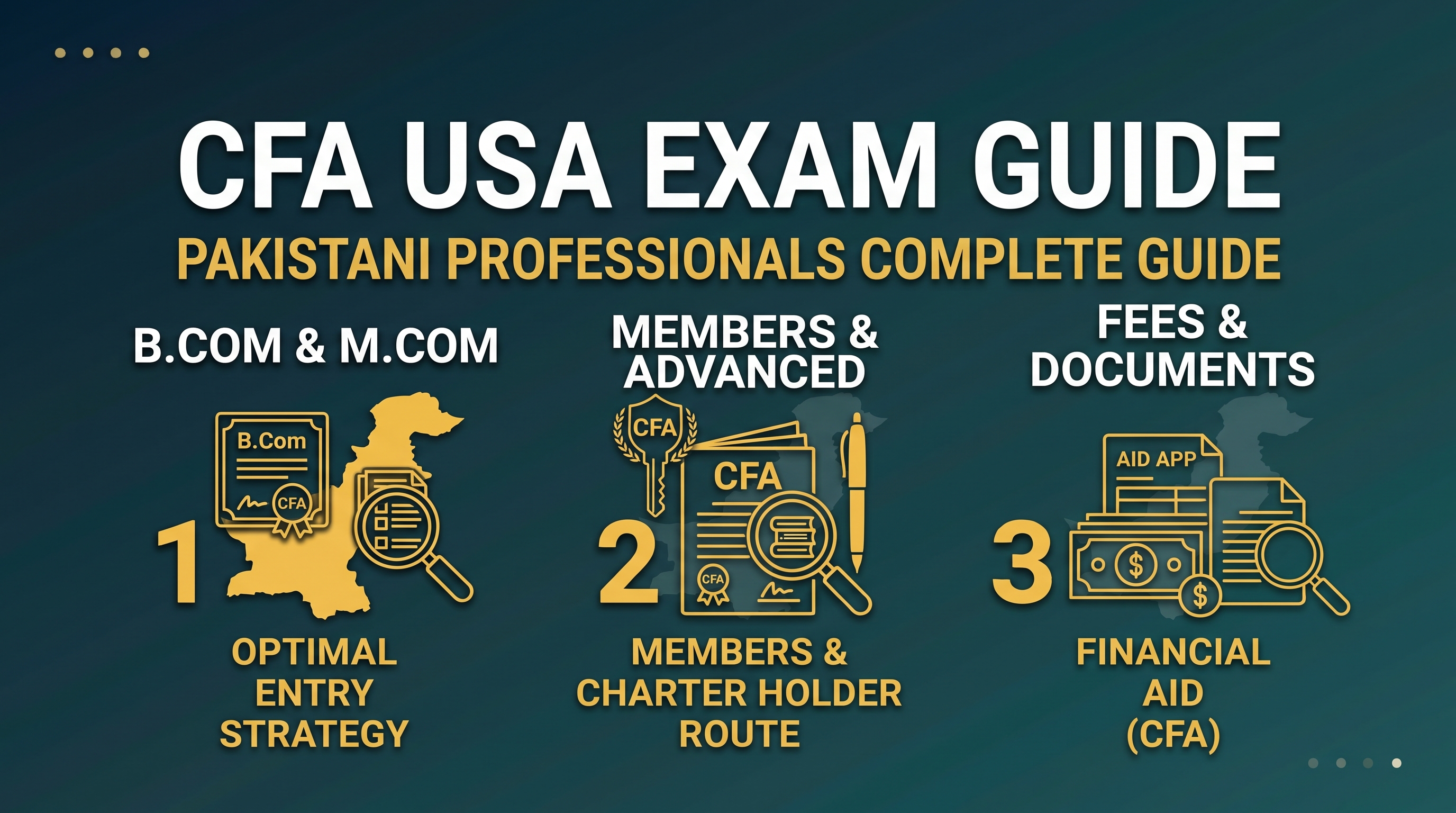
The CFA — Chartered Financial Analyst — is the most prestigious credential in the investment management world. Awarded by the CFA Institute USA, it is recognised in over 170 countries and is the gold standard for professionals in investment banking, equity research, portfolio management, and financial analysis. This guide covers everything Pakistani finance professionals need to know about pursuing the CFA in 2025.
What Is the CFA and Who Is It For?
The CFA charter is earned by completing three levels of examination and accumulating at least 4,000 hours of relevant professional experience. It covers economics, financial reporting, portfolio management, equity analysis, fixed income, derivatives, and professional ethics. The CFA is specifically for investment professionals — those who work in financial markets, investment funds, brokerage firms, or wealth management. If your career is in accounting, audit, or tax, the CMA, CIA, or ACCA will serve you better. But if you work in financial markets, the CFA is the defining qualification.
CFA Exam Structure — 3 Levels
Level 1: 180 multiple-choice questions across 10 topic areas. Offered in February, May, August, and November. Topics include Ethics (15–20%), Financial Statement Analysis (11–14%), Equity (11–14%), and Fixed Income (11–14%). Global pass rate: 40–45%.
Level 2: Uses case-based "item sets" (vignettes followed by 4–6 MCQs). Focuses on asset valuation with greater depth than Level 1. Financial Statement Analysis and Equity receive the highest weightings. Pass rate: 45–50%.
Level 3: Combines essay-style constructed response questions and item sets. Tests portfolio management and wealth planning at a strategic level. Requires synthesising everything from Levels 1 and 2. Pass rate: 50–55%.
CFA Study Requirements
The CFA Institute recommends 300+ hours of study per level. Most successful candidates study 300–400 hours per level — approximately 15–20 hours per week over 4–5 months per level. Total study time across all three levels: 900–1,200 hours. The most important Level 1 topics by weight are Ethics, Fixed Income, Equity, and Financial Statement Analysis, which together account for over 50% of the exam.
CFA Eligibility for Pakistani Students
To register for CFA Level 1 you need: a bachelor's degree from an accredited institution, or final-year undergraduate status, or 4,000 hours of relevant professional work experience. Pakistani students with a 4-year HEC-recognised degree qualify. Final-year students can also register and sit the exam before graduation. The CFA charter (after all three exams) additionally requires 4,000 hours of relevant professional experience in investment-related work.
CFA Career Paths for Pakistani Professionals
- Equity Research Analyst: Covers listed companies, produces research reports, makes buy/sell/hold recommendations. Found at brokerage houses, mutual fund companies, and investment banks in Pakistan.
- Portfolio Manager: Manages investment portfolios at asset management companies. Pakistani AMCs (NIT, UBL Funds, ABL AMC, MCB Funds) seek CFA charterholders for portfolio management roles.
- Investment Banking Analyst: Works on M&A, capital raising, and financial advisory. CFA is increasingly valued alongside MBA at investment banks.
- Wealth Manager: Advises high-net-worth individuals on investment strategy. CFA carries significant credibility with wealthy clients.
- Risk Analyst: Assesses and manages financial risk at banks and investment firms.
CFA in the Gulf — Dubai DIFC and Abu Dhabi ADGM
In Gulf financial centres, particularly Dubai International Financial Centre (DIFC) and Abu Dhabi Global Market (ADGM), the CFA is widely required for senior investment roles. Pakistani professionals with CFA charters in Gulf investment firms typically earn AED 15,000–40,000/month depending on role and seniority. Demand for CFA charterholders has grown significantly with the expansion of sovereign wealth funds and regional investment firms in UAE and Saudi Arabia.
CFA vs MBA — Which Is Better for Investment Careers?
For investment management specifically, the CFA is generally preferred over an MBA from a non-top-tier institution. The CFA provides deep technical investment knowledge, costs significantly less ($4,000–6,000 total vs $50,000–150,000 for MBA), and has a globally recognised brand in financial markets. For senior leadership roles at bulge-bracket investment banks, a top MBA still carries more weight. The ideal combination for ambitious investment professionals is CFA + MBA from a strong institution.
CFA Ethics — The Topic That Can Pass or Fail You
CFA Ethics deserves special attention that goes beyond its 15-20% exam weighting. The CFA Institute applies an "ethics adjustment" to candidates whose overall score is close to the minimum passing score. If your borderline score is combined with strong Ethics performance, the adjustment works in your favour. If your borderline score is combined with weak Ethics performance, the adjustment can result in a failing grade even when your overall raw score would otherwise have been sufficient to pass.
This ethics adjustment policy means that neglecting Ethics as a study area is a high-risk strategy. Even candidates who are confident in their Ethics knowledge should complete all available Ethics practice questions and devote the final week of preparation to an intensive Ethics review. The CFAI Standards of Professional Conduct has 7 Standards with multiple sub-standards — know them cold, and practise applying them to the grey-area scenarios that the exam consistently presents. HM Rana's CFA coaching dedicates explicit sessions to Ethics application — not just the rules themselves but the reasoning framework for applying them to scenarios where the right answer is not immediately obvious.
CFA Study Resources and Preparation Strategy
The CFA Institute provides official study materials (curriculum books) for all three levels. These are comprehensive but extremely dense — many candidates find them difficult to use as primary study material without supplementary guidance. Third-party prep providers offer condensed study notes and question banks that many candidates find more practical for efficient preparation.
The most effective CFA preparation combines: structured study notes (whether official or third-party) for content learning, a large volume of practice questions (2,000-3,000+ per level) for application practice, and full-length timed mock exams in the final weeks before the exam. Passive reading without practice questions is the single most common reason for CFA Level 1 failure — the exam tests application, not recall.
CFA in the Context of Pakistani Capital Markets
Pakistan's capital markets, while smaller than Gulf or Asian regional markets, provide meaningful employment for CFA candidates and charterholders. The Pakistan Stock Exchange (PSX), SECP-regulated asset management companies, brokerage houses, and the investment banking divisions of major banks all employ CFA candidates and charterholders in research, analysis, and portfolio management roles.
CFA Society Pakistan is active in Karachi and Lahore, hosting events, networking sessions, and career development programmes. Being an active member of CFA Society Pakistan — even as a candidate — provides access to a professional network of analysts, portfolio managers, and investment professionals that can significantly accelerate a finance career in the investment sector.
Combining CFA with Other Qualifications
The CFA is most powerful when combined with relevant work experience in financial markets. A CFA charterholder with 5 years of equity research experience at a reputable brokerage or asset manager has a very strong profile for senior investment roles globally. In Pakistan and the Gulf, CFA plus relevant experience is the standard qualification for Portfolio Manager and Head of Research roles at major financial institutions.
Some Pakistani professionals combine CFA with ACCA or CA to create a comprehensive profile that covers both technical accounting (for financial statement analysis) and investment management. This combination is particularly relevant for financial analysts and equity researchers who need deep knowledge of financial reporting alongside investment analysis skills.
Official Sources and Further Reading
Fees, syllabus weightings and exam rules change from time to time. Before you commit to a study plan or a registration date, confirm the current details with the official body:
- CFA Institute — awarding body for the CFA Program — curriculum, exam registration and fees.
HM Rana CFA Coaching
HM Rana International Professional Institute offers complete CFA coaching for all three levels in Urdu/Hindi. All notes included. Recorded lectures available 24/7 for working professionals and Gulf-based students.
Book a free CFA orientation: WhatsApp +92 324 7003235 | hmufrana@gmail.com | hmranaeducation.com

Written by
HM Rana Umar Farooq
CMA USA · CIA USA · CPA USA · CFA USA · ACCA · CA Pakistan
Founder, HM Rana International Professional Institute · 16+ years coaching experience · Students in 100+ countries
Book a Free Orientation Class
No hidden charges. No obligation. Just honest guidance.
Book Free Class WhatsApp