The ACCA Ethics and Professional Skills Module: What UAE Students Actually Need to Know
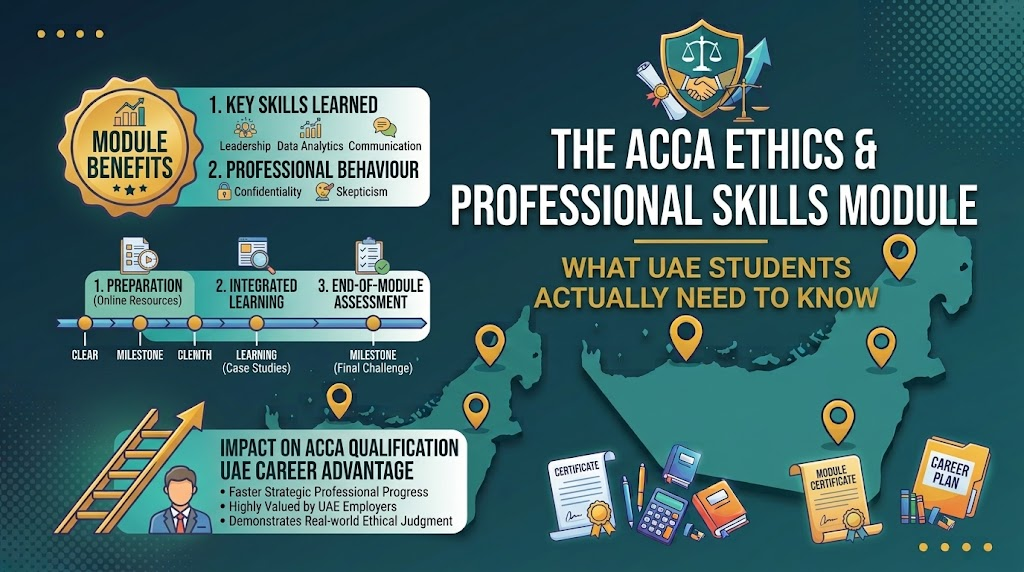
Passing your ACCA papers proves you know the technical material. It doesn't automatically prove you can handle a difficult client conversation, spot a conflict of interest, or make a judgement call when the "correct" answer isn't obvious. That's the gap the Ethics and Professional Skills Module (EPSM) is built to close — and for students working in the UAE's mixed, multinational business environment, it's more useful than most people expect going in.
What EPSM actually covers
EPSM isn't a written exam in the traditional sense. It's a series of realistic workplace scenarios delivered online, where you're asked to analyse a situation, communicate a response, and justify the judgement you made. The module is built around eight areas: communication, commercial awareness, leadership, teamwork, problem solving, professional judgement, ethical decision-making, and digital skills.
The ethics component sits at the centre of it. Rather than testing whether you know the definitions of integrity, objectivity or confidentiality, it puts you in situations where those principles conflict with something else — a deadline, a client's preference, a colleague's mistake — and asks how you'd actually respond.
Why it matters more in the UAE than the syllabus suggests
The UAE's finance sector is unusually international — you're likely to work across multiple regulatory environments, currencies and reporting standards within the same firm, sometimes the same week. EPSM's scenario-based format maps onto that reality more directly than a standard technical paper does: the situations are designed to mirror the kind of judgement calls that come up when teams, clients and regulations don't all follow the same playbook.
How long it actually takes, and when to schedule it
EPSM isn't a single sitting — it's a series of modules completed over time, and most students spread it across several weeks rather than doing it in one block. A realistic approach is to treat it the same way you'd treat a paper: block out specific sessions in your calendar rather than planning to "get to it eventually" between exam papers. Many students make the mistake of leaving EPSM until right before they apply for membership, which means rushing through scenarios that deserve real thought. Starting it earlier — once you've cleared your Applied Skills papers — gives you room to actually engage with it properly rather than treating it as a final box to tick.
How to complete it
EPSM is done entirely online through ACCA's learning platform, at your own pace within ACCA's timeline. That flexibility is genuinely useful if you're studying alongside a job — you don't need a classroom or a fixed schedule, whether you're in Dubai, Abu Dhabi or Sharjah. Check your current eligibility and exact requirements in your myACCA account, since these can be adjusted by ACCA over time.
How to approach it well
Don't treat EPSM like a technical exam you cram for. It rewards a different kind of preparation:
- Read each scenario slowly. The "obvious" first answer is often not the best one.
- Think through both the ethical angle and the commercial consequence of a decision — EPSM wants you to weigh both, not pick one.
- Picture the scenario as something that could genuinely happen to you at work: how would you actually message a manager, or handle a client who's pushing back? Concrete, not abstract.
- Set aside a proper block of quiet time for each session rather than doing it in fragments between other tasks.
What a typical scenario actually looks like
It helps to know what you're walking into before you start. A typical EPSM scenario doesn't ask "what does confidentiality mean" — it puts you inside a situation. For example: a client asks you to delay reporting a finding until after a personal event, or a colleague makes a decision you believe is technically correct but ethically questionable, and you have to decide how to respond, who to escalate to, and how to phrase that escalation without damaging a working relationship. You're then asked to justify the choice you made, not just state what the "textbook" answer would be.
This format is deliberately uncomfortable in places, because real workplace ethics rarely come with a clean, obviously-correct option. The module is testing your reasoning process as much as your final decision.
Common mistakes students make with EPSM
Because it doesn't feel like a technical exam, EPSM gets under-prepared for in fairly predictable ways:
- Rushing through scenarios because they feel easier than a technical paper, then giving surface-level answers that don't show real judgement.
- Picking the "safest sounding" answer rather than genuinely thinking through the trade-offs the scenario is testing.
- Treating the digital skills and commercial awareness sections as filler. They're graded like the rest of the module and shouldn't be an afterthought.
- Doing it in short, distracted bursts between other tasks, rather than in one focused sitting where you can actually think through each scenario properly.
How EPSM connects to your PER
EPSM isn't graded in isolation from the rest of your ACCA journey — the professional behaviours it develops are the same ones your workplace supervisor will be assessing when they sign off your Practical Experience Requirement performance objectives. Students who take EPSM seriously tend to find the PER conversations with their manager easier, simply because they've already thought through how to talk about judgement calls, communication and ethics in a structured way.
Where this fits into your ACCA journey
EPSM is a required step toward ACCA membership, alongside your exams and the Practical Experience Requirement. It's not the hardest part of the qualification, but it's the part most students under-prepare for simply because it doesn't feel like "real" studying. Treating it as professional training rather than a box to tick will serve you better once you're actually managing these situations at work.
FAQs
Can I complete EPSM fully online while working in the UAE? Yes — it's designed for exactly that. No physical attendance is required.
Is EPSM required for every ACCA student? Requirements can be adjusted by ACCA, so confirm your specific status in myACCA. For most students it's a required part of the path to membership.
Written by
HM Rana Umar Farooq
CMA USA · CIA USA · CPA USA · CFA USA · ACCA · CA Pakistan
Founder, HM Rana International Professional Institute · 16+ years coaching experience · Students in 100+ countries
Book a Free Orientation Class
No hidden charges. No obligation. Just honest guidance.
Book Free ClassWhatsApp