CMA USA Part 1 — Financial Planning, Performance and Analytics Explained
CMA Part 1 Essay Questions — What to Expect
The Part 1 essay section has 2 questions worth 25% of your total score. Essays are only graded if you achieve a passing score on the MCQ section (scoring above the minimum threshold). Each essay should be answered in approximately 20-25 minutes. The essays require written responses to scenarios that test your ability to apply CMA concepts to business situations — they are not asking for definitions or descriptions of accounting standards.
Common Part 1 essay topics include: variance analysis interpretation and management implications, budget preparation and justification, performance measurement system design, cost-benefit analysis of a business decision, and internal control assessment. In each case, the expected response is analytical — you are advising a management team, not writing a textbook explanation.
The most effective essay preparation involves practising responses to past IMA essay questions under timed conditions. Write complete responses — not bullet points or notes — and compare them against the IMA's model answers. Model answers are structured, concise, and directly address the specific scenario rather than providing general accounting knowledge.
CMA Part 1 vs Part 2 — Which Should You Take First?
The IMA allows candidates to take Part 1 and Part 2 in any order. Most candidates and coaches recommend starting with Part 1 for two reasons. First, the financial planning and performance management content of Part 1 is closely related to the decision analysis and corporate finance content of Part 2 — studying them in order provides better contextual understanding. Second, Part 2 Decision Analysis (25% of Part 2 score) builds directly on the cost-volume-profit and performance analysis concepts from Part 1.
However, some candidates who work specifically in corporate finance or treasury prefer to start with Part 2 because it more directly covers the work they do daily. Both approaches can work — the most important factor is genuine engagement with the content rather than which part comes first.
Maintaining Your CMA — CPE Requirements
After earning the CMA, IMA requires 30 hours of Continuing Professional Education (CPE) annually to maintain the certification. Of these 30 hours, 2 hours must specifically cover professional ethics. CPE can be earned through IMA webinars and seminars, accounting and finance conferences, relevant online courses, university courses, and documented self-study using IMA-approved materials. IMA makes many CPE resources available to members through the IMA Knowledge Hub, making it straightforward to meet the annual requirement without significant additional cost.
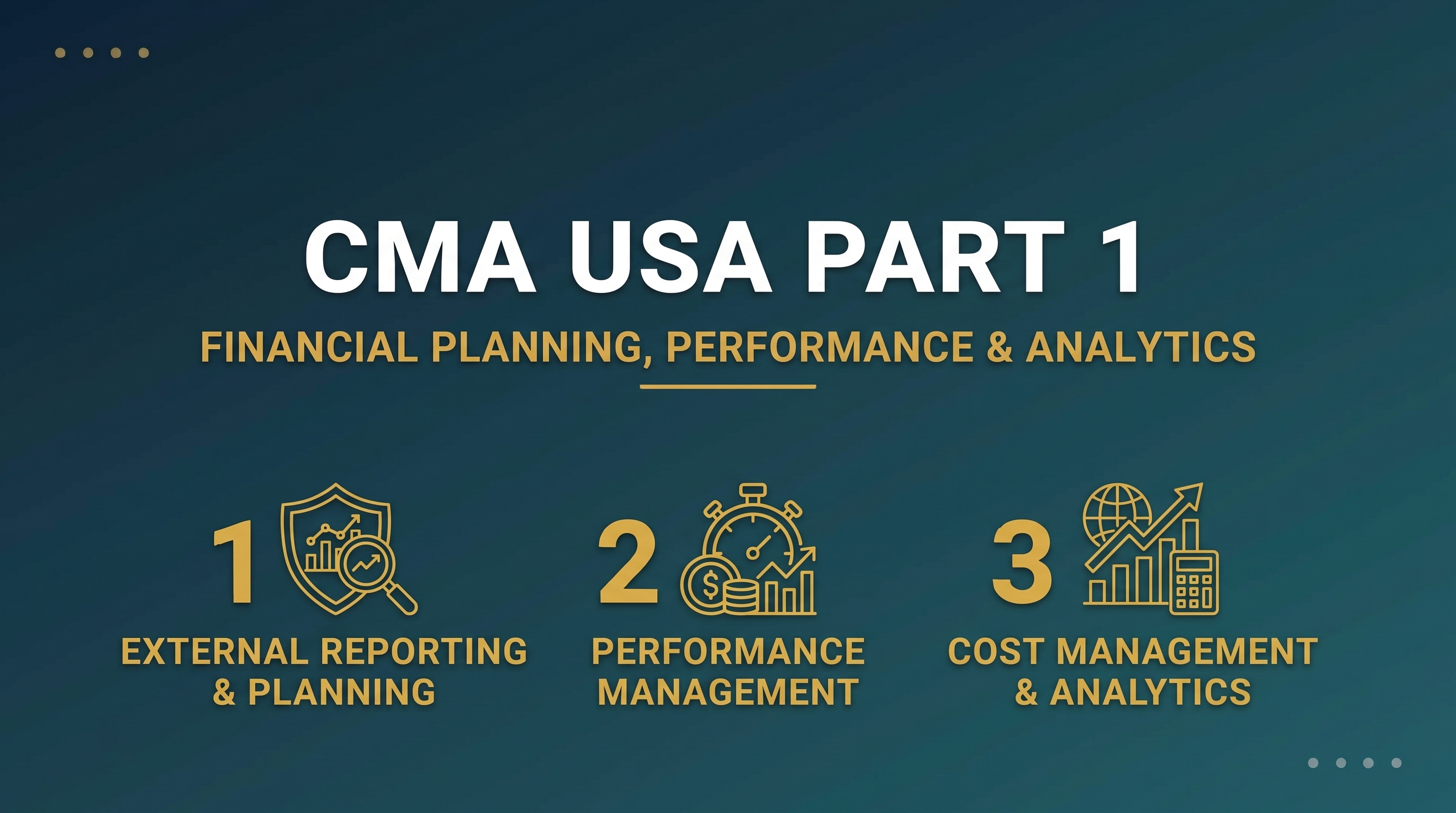
CMA USA Part 1 — Financial Planning, Performance and Analytics — is the first of the two CMA exam parts and covers six major topic areas. Understanding the structure, content, and topic weightings of Part 1 is the foundation of effective preparation. This guide provides a thorough breakdown of every topic area, explains what the exam actually tests, and gives you the study strategy needed to pass Part 1 on your first attempt.
Part 1 Exam Format
CMA Part 1 has 100 multiple-choice questions (3 hours) plus 2 essay questions (1 hour) — 4 hours total. MCQs are worth 75% of your score; essays are 25%. Essays are only graded if you achieve a passing raw score on the MCQ section. The passing score is 360 out of 500. Part 1 can be taken in the January/February, May/June, or September/October exam windows each year.
Topic 1: External Financial Reporting Decisions (15%)
This topic covers the preparation and presentation of financial statements under US GAAP and IFRS. Key areas include: income statement preparation and presentation, balance sheet classification and measurement, cash flow statement (direct and indirect methods), statement of changes in equity, and differences between IFRS and US GAAP treatment for key items. While this is one of two lower-weighted topics (both at 15%), it often trips up candidates from non-US accounting backgrounds because of the emphasis on US GAAP. Study the key measurement and classification differences between GAAP and IFRS carefully.
Topic 2: Planning, Budgeting and Forecasting (20%)
The highest-weighted topic in Part 1 at 20%. Covers strategic planning processes, the entire budgeting cycle, budget preparation and types (operating, financial, capital), flexible budgets vs static budgets, rolling forecasts and continuous planning, revenue and cost projections, sensitivity analysis, and scenario planning. This topic is directly relevant to the day-to-day work of FP&A professionals and management accountants. Candidates who work in these functions often find this the most intuitive section. Focus on the calculations — budget preparation, variance reconciliation, and flexible budget analysis are frequently tested.
Topic 3: Performance Management (20%)
Co-highest weighted at 20%. Covers cost and variance analysis (the most calculation-intensive section of Part 1), revenue and profitability analysis, cost allocation methods, responsibility accounting, transfer pricing, business performance metrics, and the Balanced Scorecard framework. Variance analysis is the most heavily tested area within performance management — you must be comfortable calculating and interpreting direct material, direct labour, variable overhead, and fixed overhead variances. Practice variance analysis calculations repeatedly until they are automatic.
Topic 4: Cost Management (15%)
Covers measurement concepts, costing systems (job order, process, activity-based), cost behaviour (fixed, variable, semi-variable, step), cost-volume-profit (CVP) analysis, break-even analysis, cost of quality, and supply chain management. CVP and break-even analysis are frequently tested with both calculation and interpretive questions. Activity-Based Costing (ABC) is also a regular exam topic — understand how ABC differs from traditional absorption costing and when each is more appropriate.
Topic 5: Internal Controls (15%)
Covers the control environment, risk assessment, control activities, information and communication, and monitoring components of the COSO Internal Control framework. Also covers types of controls (preventive, detective, corrective), segregation of duties, IT controls, the Sarbanes-Oxley Act (SOX) requirements, and auditing concepts for management accountants. This topic is more conceptual than computational — understanding the COSO framework and how controls work in practice is more important than memorising definitions.
Topic 6: Technology and Analytics (15%)
The most recently added topic area, reflecting the increasing role of technology in finance. Covers: information systems fundamentals, data governance and data management, business intelligence (BI) tools, data analytics and visualisation, big data concepts, process automation, robotic process automation (RPA), artificial intelligence in finance, and blockchain and digital currencies. This topic is the most conceptual in Part 1 — questions test understanding and awareness rather than calculation skills. Read the IMA's SMA on Data Analytics and related research publications as supplementary material.
CMA Part 1 Study Strategy
Allocate study time proportionally to topic weights. Planning, Budgeting and Forecasting (20%) and Performance Management (20%) together account for 40% of your score — give them 40% of your study time. Practise the calculations in these topics extensively. External Financial Reporting, Cost Management, Internal Controls, and Technology each deserve approximately 15% of your study effort.
Aim for 2,000+ Part 1 MCQ practice questions before exam day. After each practice session, analyse your performance by topic — not just your overall percentage. Weak areas identified early can be addressed before they cost marks on exam day.
Official Sources and Further Reading
Fees, syllabus weightings and exam rules change from time to time. Before you commit to a study plan or a registration date, confirm the current details with the official body:
- Institute of Management Accountants (IMA) — awarding body for the CMA — official content outlines, learning outcome statements, fees and registration rules.
HM Rana CMA Part 1 Coaching
HM Rana International Professional Institute provides complete CMA Part 1 coaching in Urdu/Hindi. All topic areas are covered with structured notes and MCQ practice included in the course fee — no hidden charges. Book a free orientation class to start your Part 1 preparation.
WhatsApp/Call: +92 324 7003235 | Email: hmufrana@gmail.com | hmranaeducation.com

Written by
HM Rana Umar Farooq
CMA USA · CIA USA · CPA USA · CFA USA · ACCA · CA Pakistan
Founder, HM Rana International Professional Institute · 16+ years coaching experience · Students in 100+ countries
Ready to Start Your Journey?
Book a free orientation class with HM Rana — no obligation, no hidden charges.
Book Free Orientation WhatsApp