The 6-Step CMA USA Study Method: From First Concept to Exam-Ready
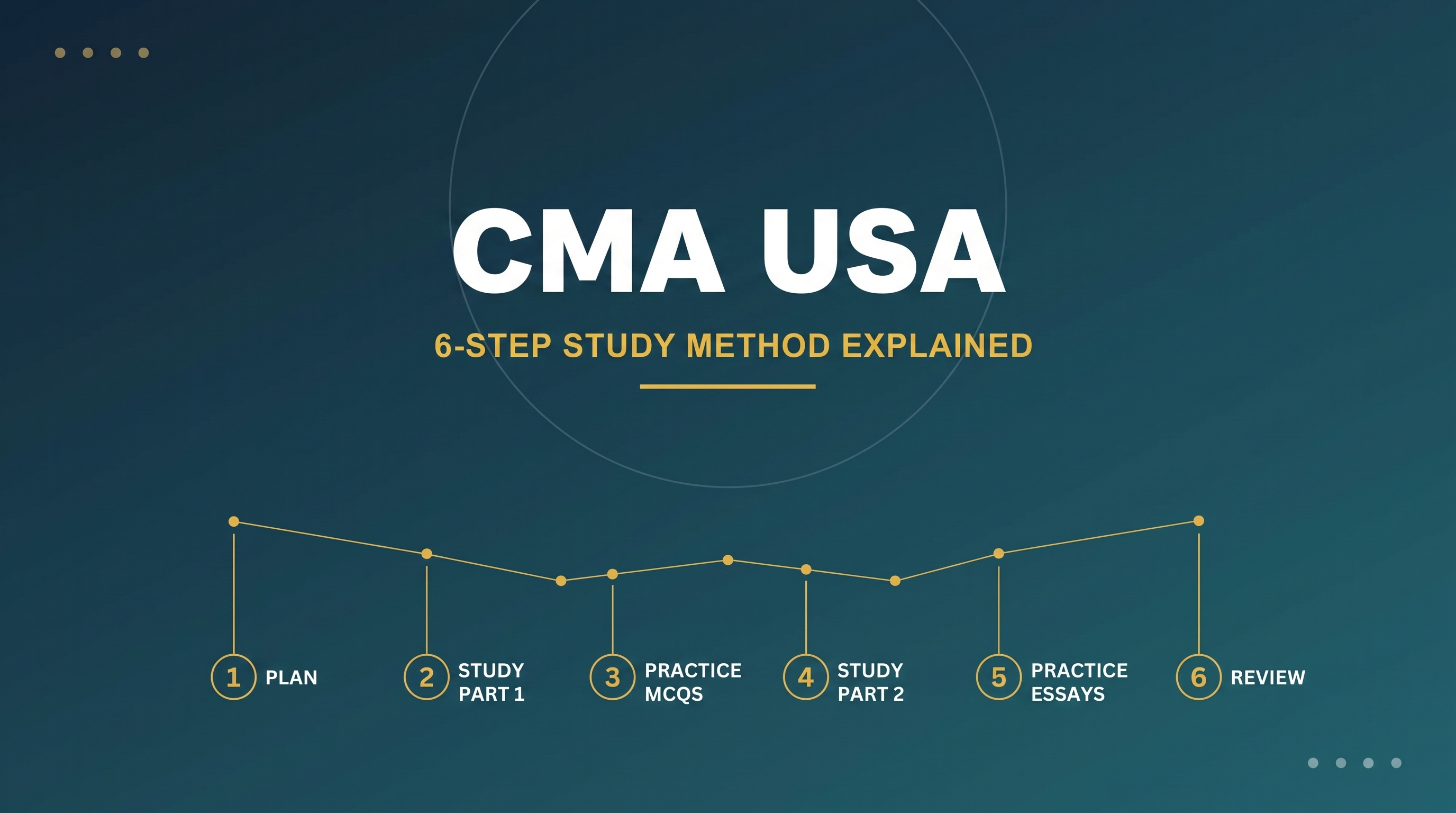
Most CMA USA guidance covers what to study — which competency areas carry the most weight, which topics dominate Part 1 versus Part 2. That's useful, but it's a syllabus map, not a study plan. It doesn't tell you what actually happens between the day you first meet a topic and the day you can answer an exam-style question on it without hesitating. That gap is where a structured method matters more than the topic list itself, and it's the part of CMA preparation that gets talked about the least.
Why "Understanding a Topic" and "Being Exam-Ready" Are Different Things
It's a familiar pattern: a candidate sits through a lecture on variance analysis or cost-volume-profit, nods along, feels like it makes sense — and then blanks when a mock exam question phrases the same idea differently, or combines it with a second concept from earlier in the chapter. That isn't a knowledge problem. It's a practice-sequencing problem. Watching or reading a concept once builds recognition, not recall under pressure, and recall under pressure is the only thing the actual CMA exam measures.
Closing that gap requires more than "more practice questions." It requires practice at the right moments, in the right order, at increasing levels of difficulty — which is the reasoning behind structuring every CMA topic at HM Rana Institute through the same six-stage progression, regardless of which part or which competency is being taught.
The Six Stages, Applied to Every Topic
The Six Stages in Action — A Worked Example
The six stages are easier to picture applied to a real CMA Part 1 topic than described in the abstract. Take variance analysis, a core piece of the Performance Management competency: first, the concept of a "variance" — the gap between planned and actual results — is taught on its own, starting with a single variance type such as the materials price variance, before any other variance is introduced. Second, students immediately attempt objective questions computing that one variance type alone, confirming the mechanics are solid before adding complexity.
Third, once materials, labor, and overhead variances have each been taught individually, section-wise practice mixes them together — testing whether a student can correctly identify which variance a question is actually asking about, not just calculate correctly once told. Fourth, chapter-wise practice folds variance analysis in alongside the rest of Performance Management, including responsibility accounting and performance measures, since real exam questions rarely isolate one topic from its neighbors. Fifth, exam-pattern mocks present variance analysis the way the actual CMA exam does — blended with other Part 1 competencies inside realistic question phrasing. Sixth, a case-based question asks the student to diagnose why a division underperformed, using variance analysis as one tool among several within a broader business narrative, exactly as a real management accountant would apply it on the job.
What It Means When a Student Gets Stuck at a Particular Stage
One underrated benefit of this structure is diagnostic: where a student struggles reveals what's actually wrong, rather than leaving both student and instructor guessing. A student who struggles at Stage 1 or 2 — the single-concept stage — usually has a genuine gap in understanding the concept itself, and the fix is re-teaching that concept, not more practice. A student who sails through Stages 1 and 2 but stumbles at Stage 3 or 4 has a different problem entirely: they understand each concept individually but can't yet distinguish between similar-looking ones under mixed conditions — a materials variance question that looks superficially like a labor variance question, for instance. That calls for targeted comparison practice between the easily-confused concepts, not a re-explanation of either one alone. And a student who handles Stages 1 through 5 well but struggles specifically with Stage 6 case-based questions usually has a synthesis gap — they know the pieces but haven't yet built the judgment to apply several of them together inside a realistic, messier business scenario. Each of these is a different kind of gap, and each needs a different fix — which is only possible to see clearly because the six stages are kept separate rather than blended into generic "practice."
Why the Sequence Matters More Than Total Hours Studied
Two candidates can log the identical number of study hours and land in very different places on exam day, because hours alone don't determine readiness — what happens during those hours does. A candidate who reads a chapter twice and does one mixed question set at the end has technically "studied," but has never actually practiced isolating a single concept, then recombining it, then applying it inside a case scenario. Those are three distinct skills, and each one has to be built and tested separately before they're expected to work together. Skipping straight to mixed practice or mock exams without the earlier stages is a common reason candidates who otherwise know the material still find the real exam harder than expected.
How This Fits Into the Rest of CMA Preparation
This six-stage structure isn't a replacement for understanding the exam's competency weightings — the two work together. Knowing that Decision Analysis carries the largest single weighting in Part 2, for example, tells a student where to spend more time; the six-stage method is what that time is actually spent doing once a student sits down to study it. For a full breakdown of what each CMA competency area covers and how much of the exam it represents, see the CMA USA Part 1 breakdown and the exam-weighted study tips on the CMA USA course page.
This same six-stage progression is applied consistently across every topic in both CMA USA Part 1 and Part 2 — not selectively to a few chapters — which is what allows students to move from feeling merely familiar with a topic to genuinely ready to be tested on it.
WhatsApp/Call: +92 324 7003235 | Email: hmufrana@gmail.com | hmranaeducation.com
Official Sources and Further Reading
Fees, syllabus weightings and exam rules change from time to time. Before you commit to a study plan or a registration date, confirm the current details with the official body:
- Institute of Management Accountants (IMA) — awarding body for the CMA — official content outlines, learning outcome statements, fees and registration rules.

Written by
HM Rana Umar Farooq
CMA USA · CIA USA · CPA USA · CFA USA · ACCA · Certificate in IFRS · CA Pakistan
Founder, HM Rana International Professional Institute · 16+ years coaching experience · Students in 100+ countries
See the Six-Stage Method in Action
Book a free orientation and sit in on how a real CMA USA topic is taught, practiced, and tested — before you enroll.
Book Free Orientation WhatsApp